Tax withholding checkup: will you owe or get a refund?
Withholding is a prepayment, not the bill. On a $60,000 salary with one job and a blank W-4, the year withholds $5,020.08 and the 2026 brackets put $5,020.00 on the wages. A side income, a credit or a second job is what moves the two apart.
One paycheck is one guess
Take a single worker in Texas earning $60,000, paid every two weeks. Each check is $2,307.69. Federal income tax is $193.08, Social Security $143.08, Medicare $33.46, and the deposit is $1,938.07. Twenty-six of those federal lines add up to $5,020.08.
That is payroll’s guess at the year’s tax, built only from the W-4. Here it lands within $0.08 of the $5,020.00 the 2026 brackets put on $60,000 after the standard deduction, because this worker has one job, no other income and no credits. Payroll does not know about a side gig, a credit or a deduction unless the W-4 says so. When you file, the real tax is compared with what was withheld. The difference is the refund or the bill.
A refund is withholding you did not need
Say the same worker put $77 in Step 4(c), extra withholding each pay period. Federal tax per check rises from $193.08 to $270.08, and the deposit falls from $1,938.07 to $1,861.07. Over 26 checks that is $2,002.00 more withheld than the tax, and it comes back as a refund the next spring.
Form W-4 describes Step 4(c) exactly that way: an amount there reduces your paycheck and either increases your refund or reduces what you owe. Some people want that as forced savings. It is a choice, and the checkup lets you make it on purpose.
Why people owe instead
The usual reasons are a second job, a spouse who started working, a side gig, or a change such as losing a credit. Take the same worker with $10,000 of freelance income. No one withholds on it. Federal income tax on $70,000 of income instead of $60,000, with the standard deduction, is $6,570.00 instead of $5,020.00: $1,550.00 more, with nothing withheld toward it. Self-employment tax on that income comes on top and is not in this figure.
Two W-2 jobs create a similar gap, because each employer gives you a full standard deduction. W-4 with two jobs shows that gap for two $40,000 jobs and for a married couple.
A bill is not always a penalty
IRS Publication 505 says you generally must make estimated payments only if you expect to owe at least $1,000 after withholding and credits, and your withholding and credits will be less than the smaller of 90% of this year’s tax or 100% of last year’s. Higher-income taxpayers, and farmers and fishers, use different percentages; Form 2210 and its instructions have the details.
The freelancer above owes $1,550.00, more than $1,000. If their withholding still covers last year’s full tax, the second test can keep them clear of the penalty. It is still a bill, just not a fine.
Shrinking a big refund
If the checkup says you will get a large refund, add what the W-4 does not know. A parent with one child under 17 who never filled in Step 3 can enter $2,200 there. Federal tax per check falls from $193.08 to $108.46, and the deposit rises to $2,022.69. The child tax credit guide has the details.
Expected deductions beyond the standard deduction go in Step 4(b). The 2026 Deductions Worksheet has lines for qualified tips, qualified overtime, passenger vehicle loan interest and the deduction for people 65 or older, as well as itemized deductions. Each entry is an estimate, so size it with the estimator.
Closing a bill with Step 4(c)
Spread across a full year, the freelancer’s $1,550.00 is $59.62 a check. Late in the year there are fewer checks to spread it over. With six paychecks left, it is $258.33 a check. Entered in Step 4(c), federal tax on each of those checks becomes $451.41 and the deposit falls to $1,679.74. The year then withholds $6,570.06 against $6,570.00.
A new W-4 can go to payroll at any time. Publication 15 says the employer must apply a replacement W-4 no later than the first payroll period ending on or after the 30th day after receiving it, so allow a check or two.
The checkup, step by step
Open the IRS Tax Withholding Estimator with your most recent pay stub, and your spouse’s if you file jointly. Bring last year’s return if you have other income or might itemize. The estimator compares the year’s withholding with your expected tax and can produce a filled-in W-4.
If you would owe, put the extra per check in Step 4(c). If you would get a large refund you do not want, use the estimator’s figures for Step 3 or Step 4(b). Give the new W-4 to payroll, then check the next stub in the paycheck calculator. The W-4 itself suggests rechecking at the beginning of each year, and after a change in jobs, marital status, dependents, income or deductions. This is not tax advice.
| Situation | Withheld for the year | Tax on the income | Result |
|---|---|---|---|
| One job, blank W-4 | $5,020.08 | $5,020.00 | even ($0.08 over) |
| One job, $77 in Step 4(c) | $7,022.08 | $5,020.00 | $2,002.08 refund |
| Plus $10,000 freelance income, blank W-4 | $5,020.08 | $6,570.00 | $1,549.92 owed |
| Plus freelance, $258.33 in Step 4(c) for the last 6 checks | $6,570.06 | $6,570.00 | even ($0.06 over) |
Watch it worked through
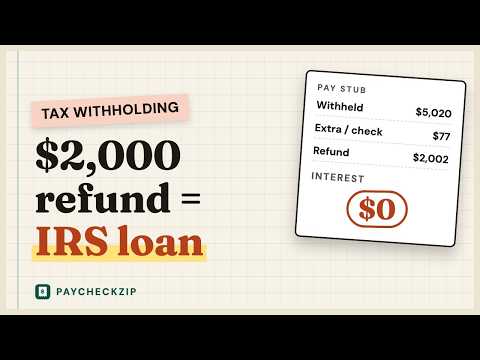
- Tax Withholding: A $2,000 Refund Is a Loan to the IRS (YouTube Short)
Paycheck Zip videos use the same calculator as this page. Figures in a video are from the day it was made; the page is kept current.
Sources
Keep reading
Questions
How do I check my tax withholding?
Use the IRS Tax Withholding Estimator with a recent pay stub. It compares your year’s withholding with your expected tax and can produce a new W-4.
Is a big refund a bad thing?
It means more was withheld than needed. $77 extra a check is $2,002.00 for the year, held until you file. Some people want that; it is a choice.
When will I owe a penalty?
Generally not if you owe less than $1,000 after withholding, or if withholding covers the smaller of 90% of this year’s tax or 100% of last year’s (different rules apply at higher incomes).
How quickly does a new W-4 change my paycheck?
The employer must start using it no later than the first payroll period ending on or after the 30th day after receiving it.
Does the checkup change Social Security or Medicare?
No. Those are fixed percentages of wages. The W-4 only changes federal income tax withholding.