401(k) contribution limit 2026
The 2026 employee limit is $24,500. People 50 and older can add $8,000, and ages 60 to 63 can add $11,250 instead. Late in the year the question is pace: at $90,000 in Texas with 4 paychecks left and $6,000 still to contribute, maxing out takes about 43% of each check, and take-home drops about $1,229 a check. (At $60,000 with 6 left it is 43% of each check.)
| Who | Employee limit | How it is built |
|---|---|---|
| Under 50 | $24,500 | Base limit (IRS, November 2025 release) |
| 50 and older | $32,500 | $24,500 plus the $8,000 catch-up |
| Ages 60 to 63 | $35,750 | $24,500 plus the $11,250 super catch-up in place of the $8,000 |
The limits
The base limit is $24,500 for 2026, announced by the IRS in November 2025 (IRS release). The catch-up for age 50 and older is $8,000, and the higher catch-up for ages 60 to 63 is $11,250 (IRS catch-up contributions).
Roth catch-up rule: from 2026, a participant whose prior-year FICA wages (W-2 box 3) from the plan sponsor exceeded $150,000 must make catch-up contributions as Roth contributions (IRS Notice 2025-67). That changes the check: Roth catch-up money does not lower this year’s federal income tax.
How the pacing table works
Find the 401(k) line on your latest stub’s year-to-date column, subtract it from the limit, and divide by the checks left. The table does that for $6,000 still to go and shows the result as a percent of gross pay. It then asks the engine what that contribution does to take-home. The federal income tax avoided is why the drop in take-home is smaller than the contribution. Social Security and Medicare are not reduced by a traditional 401(k), so the table leaves them alone.
If your employer’s payroll runs on a different schedule, use the same steps with your own check count. Many plans stop deferrals when you reach the limit, so ask payroll whether yours does, and check that your final December check is not the one that gets skipped.
Match and timing
Some plans match per paycheck rather than per year. Loading the contributions into the last few checks can reduce the match you would have earned across the year. Check your plan document before you compress deferrals, and keep the estimate in mind: this page is not tax advice.
Next steps: the paycheck deduction calculator for your own salary, the HSA vs FSA page for open enrollment, and the Social Security wage base for 2027.
| Paychecks left | $60,000: percent of pay | $60,000: take-home drop per check | $90,000: percent of pay | $90,000: take-home drop per check | $150,000: percent of pay | $150,000: take-home drop per check |
|---|---|---|---|---|---|---|
| 1 left | Not reachable | More than the check allows | Not reachable | More than the check allows | Not reachable | More than the check allows |
| 2 left | Not reachable | More than the check allows | Not reachable | More than the check allows | 52.0% | $2,318 |
| 3 left | Not reachable | More than the check allows | 57.8% | $1,669 | 34.7% | $1,538 |
| 4 left | 65.0% | $1,325 | 43.3% | $1,229 | 26.0% | $1,148 |
| 5 left | 52.0% | $1,056 | 34.7% | $965 | 20.8% | $914 |
| 6 left | 43.3% | $880 | 28.9% | $789 | 17.3% | $760 |
Watch it worked through
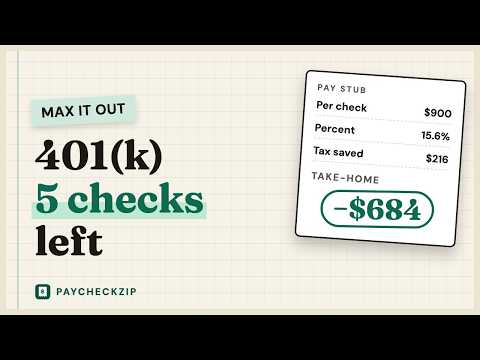
- Max Your 401k Before Dec 31 (YouTube Short)
Paycheck Zip videos use the same calculator as this page. Figures in a video are from the day it was made; the page is kept current.
Sources
Keep reading
Questions
What is the 401(k) contribution limit for 2026?
$24,500 for employee deferrals, up from $23,500 in 2025 (IRS). People 50 and older can add a $8,000 catch-up, and people ages 60 to 63 can add $11,250 instead.
What is the super catch-up for ages 60 to 63?
A higher catch-up under SECURE 2.0 for people who are 60, 61, 62 or 63 during the year: $11,250 for 2026 instead of $8,000, so the total employee limit is $35,750.
What is the Roth catch-up rule?
Starting in 2026, if your prior-year FICA wages from the employer sponsoring the plan (W-2 box 3) were more than $150,000, your catch-up contributions must be Roth contributions in a plan that offers Roth. The threshold is $150,000 for 2026 (IRS Notice 2025-67). Your plan may need to offer a Roth option for catch-ups.
How do I max out my 401(k) with the paychecks I have left?
Subtract what you have already contributed from $24,500, divide by the checks left, and divide by your gross pay per check. Example: at $90,000 in Texas with $6,000 still to contribute and 4 checks left, you need about 43.3% of each check ($150,000), and take-home drops by about $1,229 per check.
Does the limit include my employer match?
No. The employee deferral limit applies to your own pre-tax and Roth contributions together. The match is on top, subject to a separate overall limit for the plan.
What is the 2027 limit?
The IRS had not published the 2027 401(k) limit when this page was updated (October 29, 2026). The 2026 figures came out in November 2025. This page will carry the 2027 figure once the IRS publishes it.