Why is my paycheck smaller than expected?
Put the new stub next to the last normal one and find the line that moved. On a $62,400 salary paid every two weeks in Texas, the normal deposit is $2,012.25. Each of the eight causes below moves it by a different amount.
Compare two stubs first
The fastest diagnosis is two stubs side by side. If gross pay is lower, look at hours, the pay schedule or unpaid time. If a tax line is bigger, look at the W-4, a raise, a bonus or where you work. If a new deduction appeared, a benefit changed. If every line matches and the deposit is still lower, the deposit may be split between two accounts.
The example is a single filer earning $62,400, paid every two weeks, in Texas: $2,400.00 gross, $204.15 federal income tax, $148.80 Social Security, $34.80 Medicare, $2,012.25 take-home. The table below prices every cause on that stub. How to check a pay stub is the line-by-line version.
1. A new W-4
Same salary, same job, one checkbox: with Step 2 checked, federal income tax jumps from $204.15 to $359.35 and the deposit drops $155.20. Step 2 is for people with two jobs, where each employer withholds as if it were the only one. If it fits you, the smaller check is a bill you would otherwise pay in April (W-4 with two jobs). If it was checked by mistake, a new W-4 fixes it. Publication 15 says the employer must apply it no later than the first payroll period ending on or after the 30th day after receiving it.
2. A benefit starts or costs more
Benefits often change on January 1, after open enrollment. A traditional 401(k) at 5% takes $120.00 a check, but take-home falls only $105.60, because that money skips federal income tax. Social Security and Medicare still apply to it.
A pre-tax health premium that rises from $120 to $180 a check cuts take-home by $48.21, not $60, because a cafeteria-plan premium also lowers income tax, Social Security and Medicare. The paycheck deduction calculator shows what each deduction type does.
3. A different pay schedule or fewer hours
If an employer moves from twice a month to every two weeks, the same $62,400 is split into 26 checks instead of 24. Gross per check falls from $2,600.00 to $2,400.00, and take-home from $2,179.93 to $2,012.25: $167.68 less per check. The year’s pay has not changed. Biweekly vs semi-monthly pay compares the two calendars.
Hourly workers see the same thing when a period has fewer hours, an unpaid holiday or unpaid time off: gross shrinks first, then every line under it. Some years a biweekly calendar has a 27th payday, and some employers then divide the salary by 27. Ask payroll how many paydays your year has.
4. A bonus or a raise
A bonus paid with its own withholding is usually taxed at the optional flat 22% federal rate for supplemental wages, under Publication 15, plus Social Security and Medicare. In Texas a $5,000 bonus adds $3,517.50 to the deposit, not $5,000. The check that carries the bonus looks odd because the bonus is withheld separately from the regular pay. The bonus tax calculator runs it for any state.
A $5,000 raise adds $192.31 to gross per check but $151.06 to take-home. Withholding rises with the raise, but only on the new dollars; 2026 tax brackets shows why a raise cannot lower take-home through the brackets.
5. Social Security starts over in January
Higher earners see this one every year. Social Security tax stops once wages from one employer pass $184,500 for 2026, so the late checks of the year grow. On January 1 the count starts over. On a $250,000 salary, a December check takes home $7,416.19. The first January check takes home $6,906.58, $509.61 less. (The December check also carries the 0.9% Additional Medicare tax that starts after $200,000 of wages, which is why the gap is smaller than the $596.15 Social Security line.)
If you earn less than the wage base, this never touches you. The Social Security Administration has set the 2027 wage base at $192,300, so next year the tax stops a little later. See the 2027 wage base article.
6. A state or city tax
Where you work sets the next lines. Move the same $62,400 job from Texas to New York City and take-home falls from $2,012.25 to $1,818.94, $193.31 less per check: New York State tax of $106.64, New York City tax of $76.30 and Paid Family Leave of $10.37 appear. A move, a new office location or a new local tax all add lines like these. Remote workers should ask payroll which state it is withholding for. Does my city tax my paycheck lists the city taxes this site models.
7. A pre-tax deduction
A new $120 pre-tax health premium lowers take-home by $96.42, less than $120, because it comes out before federal income tax, Social Security and Medicare are figured. Those lines shrink a little at the same time, which can make the net change look smaller than the deduction itself.
8. A deduction taken after tax
The same $120 taken after tax, such as a Roth 401(k), union dues or a garnishment, lowers take-home by the full $120.00. Both look like “a deduction”; the stub tells them apart by the section the line sits in. A new garnishment or wage assignment surprises people most, because it takes the full amount. The wage garnishment calculator shows the federal limits.
Still stuck after comparing the stubs? Ask payroll to explain the line that moved. A line you cannot explain is always worth one email. This is not tax advice.
| Cause | What changed | Take-home per check | Change |
|---|---|---|---|
| Normal check | Blank 2020-or-later W-4, no benefits | $2,012.25 | |
| 1. New W-4 | Step 2 box checked | $1,857.05 | −$155.20 |
| 2. Benefit starts | Traditional 401(k) at 5% | $1,906.65 | −$105.60 |
| 2. Benefit costs more | Pre-tax health premium $120 → $180 | $1,867.62 | −$48.21 |
| 3. Pay schedule | Twice a month → every two weeks | $2,012.25 | −$167.68 |
| 4. Bonus | $5,000 bonus, flat 22% federal | $5,529.75 | +$3,517.50 |
| 4. Raise | $62,400 → $67,400 | $2,163.31 | +$151.06 |
| 5. Social Security resets | $250,000 salary, December → January | $6,906.58 | −$509.61 |
| 6. State and city | Texas → New York City | $1,818.94 | −$193.31 |
| 7. Pre-tax deduction | $120 health premium (cafeteria plan) | $1,915.83 | −$96.42 |
| 8. After-tax deduction | $120 Roth, dues or garnishment | $1,892.25 | −$120.00 |
Watch it worked through
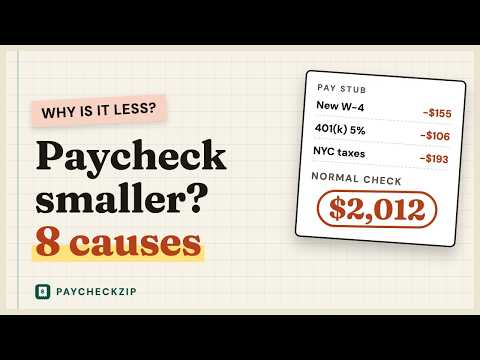
- Why Is My Paycheck Smaller? Find the Line That Moved (YouTube Short)
Paycheck Zip videos use the same calculator as this page. Figures in a video are from the day it was made; the page is kept current.
Sources
Keep reading
Questions
Why is my paycheck smaller this month?
Something on the stub changed: usually the W-4, a benefit, the pay schedule or hours, a bonus or raise, Social Security restarting in January, a state or city tax, or a new deduction. Compare the new stub with the last normal one.
Why did my paycheck go down in January?
Benefit elections often start January 1, and for high earners Social Security tax starts over after stopping at $184,500 the year before.
Why does a $120 deduction lower my pay by less than $120?
A pre-tax deduction also lowers the tax lines. On the example, a $120 cafeteria-plan premium lowers take-home by $96.42. A $120 after-tax deduction lowers it by the full $120.
Why is my bonus check taxed so much?
A bonus paid separately is often withheld at a flat 22% federal rate plus Social Security and Medicare. That is withholding, not the final tax; the return settles it.
How fast does a W-4 change show up?
The employer must use a replacement W-4 no later than the first payroll period ending on or after the 30th day after receiving it.