Wage Garnishment Calculator
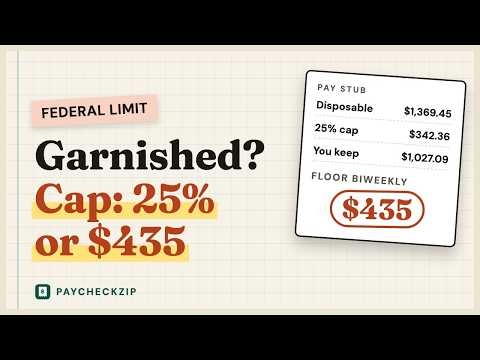
Under federal law, a creditor can garnish the lesser of 25% of your disposable earnings or the amount by which they exceed 30 times the federal minimum wage ($217.50 a week). Support orders and some federal debts have different limits.
The rule, in numbers
15 U.S.C. 1673(a) limits an ordinary garnishment to the smaller of two amounts for a workweek: 25% of disposable earnings, or disposable earnings minus 30 times the federal minimum hourly wage. At $7.25 the protected amount is $217.50 a week. For longer pay periods the Department of Labor scales the protected amount by the number of workweeks (29 CFR 870.10): 60 times the minimum wage every two weeks, 65 times twice a month, and 130 times monthly.
Below the protected amount nothing can be taken. Between the protected amount and about 133% of it, only the excess can be taken. Above that, the 25% cap applies. The table below shows each pay period.
Worked examples
Weekly disposable earnings of $400.00: 25% is $100.00 and the amount over $217.50 is $182.50. The smaller is $100.00, so $300.00 is left.
Weekly disposable earnings of $250.00: 25% is $62.50 but only $32.50 is above the protected $217.50, so the limit is $32.50 and $217.50 is left.
Biweekly disposable earnings of $1,200.00: 25% is $300.00 and the excess over $435.00 is $765.00, so the limit is $300.00.
Support order on weekly disposable earnings of $1,000.00: $500.00 (50%) if you support another spouse or child, $600.00 (60%) if you do not.
What this calculator does not do
It applies the federal limit only. It does not know your state, your court order, or the amount the creditor asked for, and the employer withholds the amount in the order, not necessarily the limit. Tax levies, bankruptcy plan payments, and student loan garnishments have their own rules. Talk to the court, the agency that issued the order, or a legal aid office about a specific garnishment.
To estimate the tax part of disposable earnings, run your pay through the paycheck calculator and read your pay stub line by line (how to read a pay stub). Sources: DOL Fact Sheet #30, 15 U.S.C. 1673, 29 CFR 870.10, and Texas Attorney General, your debt collection rights.
| Pay period | No garnishment at or below | Only the excess between | 25% cap at or above |
|---|---|---|---|
| Weekly | $217.50 | $217.50 and $290.00 | $290.00 |
| Every two weeks | $435.00 | $435.00 and $580.00 | $580.00 |
| Twice a month | $471.25 | $471.25 and $628.33 | $628.33 |
| Monthly | $942.50 | $942.50 and $1,256.66 | $1,256.66 |
Watch it worked through
- How Much of Your Paycheck Can Be Garnished? (YouTube Short)
Paycheck Zip videos use the same calculator as this page. Figures in a video are from the day it was made; the page is kept current.
Keep reading
Questions
How much of my paycheck can be garnished?
For ordinary debts such as credit cards, the lesser of 25% of disposable earnings or the amount over 30 times the federal minimum wage. That is $217.50 a week, $435.00 every two weeks, $471.25 twice a month, and $942.50 a month at the $7.25 federal minimum wage. Pay at or below that amount cannot be garnished for an ordinary debt.
What are disposable earnings?
Pay left after amounts required by law to be withheld: federal, state and local income tax, your Social Security and Medicare, and state unemployment or disability insurance contributions. Voluntary deductions such as union dues, 401(k) loans, and health insurance premiums are not subtracted for most garnishments.
How much can be taken for child support?
Up to 50% of disposable earnings if you support another spouse or child, or 60% if you do not. Add 5 points, to 55% or 65%, when the support is more than 12 weeks past due. The 30 times minimum wage floor does not apply.
What about student loans and taxes?
A defaulted federal student loan can be garnished up to 15% of disposable pay (20 U.S.C. 1095a; 31 U.S.C. 3720D), or more with your written consent. The statute sets the 15% cap; this calculator also applies the 30 times minimum wage protection to federal debts as a cautious assumption, so confirm the amount with the agency or MyEdDebt. IRS and state tax levies and Chapter 13 bankruptcy orders are not limited by the 25% consumer cap. In January 2026 the Education Department announced a delay in involuntary collections, including wage garnishment; check studentaid.gov or MyEdDebt.ed.gov for the current status, and note that you should get a written notice at least 30 days before garnishment starts.
Do state laws change the limit?
If a state sets a lower garnishment limit than the federal one, the lower limit controls. Texas is one verified example: its Attorney General says a creditor generally cannot garnish current wages for a consumer debt judgment, with exceptions for child support, back taxes and defaulted student loans. This calculator applies the federal limit only, so it can overstate what a state allows.
Is there a limit when I have more than one garnishment?
Yes. The federal limit applies to the total garnished from one paycheck, no matter how many orders the employer receives. Priority among orders is set by state or other federal law, not the Consumer Credit Protection Act.